Study Could Put Tulane at the Forefront of Concussion Research
May 27, 2019 | Football
By Evan Drexler
TulaneGreenWave.com
NEW ORLEANS – A football player's eyes, black and white and contained within two small circles, stare out from a tablet.
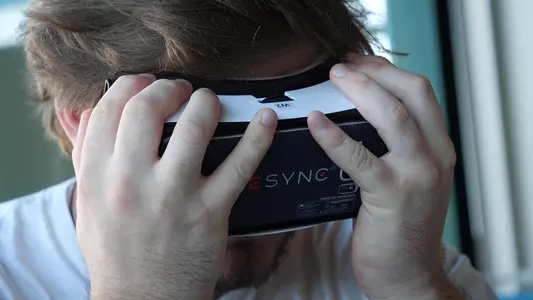
Three feet away, the athlete holds a headset tightly to his face and focuses intently on a moving red circle.
The red circle sits on the left side of the screen. It disappears and then reappears instantly on the right side. The player's eyes dart quickly to the right to catch the circle. Cameras inside the headset capture that eye movement, and a researcher monitors the results on the tablet.
The circle blinks out of existence and is reborn elsewhere on the black background. The player follows the circle everywhere it goes for about 30 seconds.
Calibration complete. Let the study begin.
This scene played out in early April at Yulman Stadium as part of a study into concussion research. The study, conducted through Tulane's Center for Sport, is analyzing the effects of sub-concussive impacts that occur during the day-to-day routine of playing football. The research is not focused on concussions themselves but on smaller, everyday hits that come in practices or during a standard tackle.
In its simplest form, the study will be checking to see whether an athlete's eye movement and balance can be used to indicate the effects of sub-concussive impacts.
Dr. Gregory Stewart, the director of Tulane's Sports Concussion Management Program, is the person who helped bring the study and its SyncThink technology to Tulane. Also the Green Wave's team physician, this type of research was a perfect fit.
"This year, we're actually starting to look at some eye movement as a part of both the evaluation for baseline testing as well as after the injury," Stewart said. "This can also actually be used to help with some of the treatment after a concussion."
The study has two major goals: See how serious sub-concussive impacts can be cumulatively and potentially develop a method to more effectively test for concussions.
Performing this sort of research could have a huge impact nationally and provide prestige and future research opportunities for Tulane, the Tulane Institute of Sports Medicine and the Center for Sport.
Alby Lindon, Tulane's head football athletic trainer, sees that as the biggest benefit of conducting this study.
"I think Tulane's really committed lately to getting back into doing research," Lindon said. "This is a way we can get notoriety because sports are on the front porch of every university, and if we can get out there and say we're testing our athletes and we've got all this data coming out in different journals, I think it does a lot for university recognition."
***
Jocelyn Simons had a concussion.
Lisa Mordell got two.
Their personal experiences with brain trauma led both of them to this study in different ways.
Simons, a Ph.D. student in Tulane's School of Medicine, worked as a speech-language pathologist for years before returning to school for another degree. A Mardi Gras mishap during her first year in New Orleans led her to see Stewart for treatment, and the two struck up a conversation about their work. Before long, Stewart became Simons' advisor.
"With my background and sustaining the concussion and meeting Doc, that got me really excited about research and the opportunity to work for him," Simons said.
Mordell, a member of the Green Wave volleyball team who is earning her master's degree in neuroscience, had her first experience with head trauma at age 11. Playing volleyball one day, she was concussed after taking a knee to the temple. Three years later, an elbow to her head gave her an even worse concussion and forced her to miss three months of action.
Concussions stayed on Mordell's brain even after their effects dissipated. The Illinois native came to college to study neuroscience as an undergraduate and knew what she wanted to work on.
"It's something that has continually affected me and my friends, and it's something I want to know more about," Mordell said.
Getting to know Stewart as a student-athlete, Mordell approached him about doing concussion research for him. Stewart heard about the SyncThink eye-tracking technology at a conference, discussed it with Mordell, and Mordell spoke with the company's representatives to bring the technology to Tulane.
Money for the study is coming from Emily's Fund, a university endowment established by the family of former Tulane physical therapist Emily McQueen. Before she passed away, McQueen worked closely with Stewart and was instrumental in prevention, management and treatment of concussions among high school and college student-athletes.
Simons and Mordell are performing the day-to-day operations of the study. They're taking volunteers from the football program through an early pilot test, setting them up with the eye-tracking software and analyzing the data. On that early April morning at Yulman Stadium, Simons explains simply how this study appeals to the Green Wave student-athletes.
"It's actually a really neat test," Simons said. "It's kind of like you're playing a video game with your eyes, so it's really fun for them."
* * *
Here's how the study works.
During spring practice, volunteers from the football team arrived at the research location and put on a white virtual reality headset. The headset consists of two cameras pointing at the athletes' eyes and a slot for a smart phone. The phone is clicked into place and connected wirelessly to a nearby tablet that runs the testing software.
The phone screen, basically right up against the athletes' faces, goes black. After a calibration process that involves moving your eyes around to find a red circle on different spots of the screen, three different tests take place:
After those eye tests, a balance test is also administered.
Participants repeat the experiments after practices, and their results are tabulated and compiled into a secure database. The data are then analyzed with statistical software. Since the study is focused on sub-concussive impacts, an athlete is removed from the study if he suffers a full concussion.
The theory behind the eye-tracking system is that when someone suffers a concussion, their eyes' ability to focus on objects and follow them decreases. Data collected after a concussion could be very different from what you would get afterward. Or, more specific to this study, a series of sub-concussive impacts over the course of normal practices might add up to worse performance in the eye test.
"So, what would normally be a nice circle, would become kind of a jagged circle when you're looking around," Stewart said. "When you're looking side to side, or up and down, the eye movement becomes kind of jumpy. And you can pick that up with this technology."
And if it helps diagnose concussions in the future, the football program is completely on board. The success of the study depends on athletes volunteering, and Coach Willie Fritz has been incredibly supportive of the study.
"He's offered to do anything he can to help us out," Lindon said. "When I ask for volunteers for the study, he's always echoing how important it is for him."
Why is the study so important to Fritz? The answer is simple. He loves football and doesn't want to see it disappear.
"I think it is great that Tulane will be at the forefront of concussion research," Fritz said. "There is so much to learn, and we want to see the game continue to thrive."
* * *
Being a part of this study is a huge point of pride for Mordell, who gets to see a topic close to her heart potentially improve the lives of her current classmates, future Green Wave athletes and possibly athletes around the country.
"I'm able to have something that's going to live on beyond me, that's going to make student athletes lives better," Mordell said. "It excites me that the people who are coming in after me are going to have a better experience than I did."
But it's not just future athletes who could benefit. The Tulane Institute of Sports Medicine and the university could see a huge return from conducting this type of study.
Besides the prestige that comes from having an experiment peer reviewed and published, research like this could put Tulane on the forefront of concussion management and treatment. That could mean more money coming into the university for more studies down the line, and that could make the Institute of Sports Medicine and the Center for Sport nationally known for their concussion research.
"We're looking at this as really kind of a beginning," Stewart said. "I think this is hopefully the beginning of us putting together a very big comprehensive program to look at brain health. And not just from concussion, but cardiovascular and metabolic health as well, and how everything plays together."
While other places across the country have conducted studies into concussions, Stewart and the rest of the group believe Tulane's study is unique in how it uses eye tracking data to monitor for sub-concussive impacts throughout normal practices.
Soon enough, the study will expand. Simons anticipates growing the testing to include athletes in other Tulane sports during the fall semester and adding more members of the football team. With more data comes better analytics, better conclusions and, maybe long term, a faster and more accurate way to diagnose concussions during game action.
And maybe all that leads to more wins on the field.
"Obviously we want to know what's going to make us better at athletics, too," Lindon said. "So that helps promote the research, and that's how we attack it. It's the next wave of Tulane. It's the next big thing we're going to get into and really grow around here."
TulaneGreenWave.com
NEW ORLEANS – A football player's eyes, black and white and contained within two small circles, stare out from a tablet.
Three feet away, the athlete holds a headset tightly to his face and focuses intently on a moving red circle.
The red circle sits on the left side of the screen. It disappears and then reappears instantly on the right side. The player's eyes dart quickly to the right to catch the circle. Cameras inside the headset capture that eye movement, and a researcher monitors the results on the tablet.
The circle blinks out of existence and is reborn elsewhere on the black background. The player follows the circle everywhere it goes for about 30 seconds.
Calibration complete. Let the study begin.
Tulane Football & @CFSTulane have partnered with @SyncThinkInc in ground-breaking concussion research.
— Tulane University Football (@GreenWaveFB) May 27, 2019
⬇️ Take a look, goggles not required 👀 pic.twitter.com/5KeqfpZRHa
This scene played out in early April at Yulman Stadium as part of a study into concussion research. The study, conducted through Tulane's Center for Sport, is analyzing the effects of sub-concussive impacts that occur during the day-to-day routine of playing football. The research is not focused on concussions themselves but on smaller, everyday hits that come in practices or during a standard tackle.
In its simplest form, the study will be checking to see whether an athlete's eye movement and balance can be used to indicate the effects of sub-concussive impacts.
Dr. Gregory Stewart, the director of Tulane's Sports Concussion Management Program, is the person who helped bring the study and its SyncThink technology to Tulane. Also the Green Wave's team physician, this type of research was a perfect fit.
"This year, we're actually starting to look at some eye movement as a part of both the evaluation for baseline testing as well as after the injury," Stewart said. "This can also actually be used to help with some of the treatment after a concussion."
The study has two major goals: See how serious sub-concussive impacts can be cumulatively and potentially develop a method to more effectively test for concussions.
Performing this sort of research could have a huge impact nationally and provide prestige and future research opportunities for Tulane, the Tulane Institute of Sports Medicine and the Center for Sport.
Alby Lindon, Tulane's head football athletic trainer, sees that as the biggest benefit of conducting this study.
"I think Tulane's really committed lately to getting back into doing research," Lindon said. "This is a way we can get notoriety because sports are on the front porch of every university, and if we can get out there and say we're testing our athletes and we've got all this data coming out in different journals, I think it does a lot for university recognition."
***
Jocelyn Simons had a concussion.
Lisa Mordell got two.
Their personal experiences with brain trauma led both of them to this study in different ways.
Simons, a Ph.D. student in Tulane's School of Medicine, worked as a speech-language pathologist for years before returning to school for another degree. A Mardi Gras mishap during her first year in New Orleans led her to see Stewart for treatment, and the two struck up a conversation about their work. Before long, Stewart became Simons' advisor.
"With my background and sustaining the concussion and meeting Doc, that got me really excited about research and the opportunity to work for him," Simons said.
Mordell, a member of the Green Wave volleyball team who is earning her master's degree in neuroscience, had her first experience with head trauma at age 11. Playing volleyball one day, she was concussed after taking a knee to the temple. Three years later, an elbow to her head gave her an even worse concussion and forced her to miss three months of action.
Concussions stayed on Mordell's brain even after their effects dissipated. The Illinois native came to college to study neuroscience as an undergraduate and knew what she wanted to work on.
"It's something that has continually affected me and my friends, and it's something I want to know more about," Mordell said.
Getting to know Stewart as a student-athlete, Mordell approached him about doing concussion research for him. Stewart heard about the SyncThink eye-tracking technology at a conference, discussed it with Mordell, and Mordell spoke with the company's representatives to bring the technology to Tulane.
Money for the study is coming from Emily's Fund, a university endowment established by the family of former Tulane physical therapist Emily McQueen. Before she passed away, McQueen worked closely with Stewart and was instrumental in prevention, management and treatment of concussions among high school and college student-athletes.
Simons and Mordell are performing the day-to-day operations of the study. They're taking volunteers from the football program through an early pilot test, setting them up with the eye-tracking software and analyzing the data. On that early April morning at Yulman Stadium, Simons explains simply how this study appeals to the Green Wave student-athletes.
"It's actually a really neat test," Simons said. "It's kind of like you're playing a video game with your eyes, so it's really fun for them."
* * *
Here's how the study works.
During spring practice, volunteers from the football team arrived at the research location and put on a white virtual reality headset. The headset consists of two cameras pointing at the athletes' eyes and a slot for a smart phone. The phone is clicked into place and connected wirelessly to a nearby tablet that runs the testing software.
The phone screen, basically right up against the athletes' faces, goes black. After a calibration process that involves moving your eyes around to find a red circle on different spots of the screen, three different tests take place:
- Participants move their eyes either horizontally or vertically back and forth repeatedly between two red dots on the left/right or top/bottom of the screen.
- Participants follow a moving red dot in a circular path repeatedly around the screen, almost as though they are rolling their eyes in an exaggerated fashion.
- Participants keep their eyes focused straight forward on a red dot while moving their head back and forth, making the dot slide horizontally or vertically between two white walls in time with a rhythm.
After those eye tests, a balance test is also administered.
Participants repeat the experiments after practices, and their results are tabulated and compiled into a secure database. The data are then analyzed with statistical software. Since the study is focused on sub-concussive impacts, an athlete is removed from the study if he suffers a full concussion.
The theory behind the eye-tracking system is that when someone suffers a concussion, their eyes' ability to focus on objects and follow them decreases. Data collected after a concussion could be very different from what you would get afterward. Or, more specific to this study, a series of sub-concussive impacts over the course of normal practices might add up to worse performance in the eye test.
"So, what would normally be a nice circle, would become kind of a jagged circle when you're looking around," Stewart said. "When you're looking side to side, or up and down, the eye movement becomes kind of jumpy. And you can pick that up with this technology."
And if it helps diagnose concussions in the future, the football program is completely on board. The success of the study depends on athletes volunteering, and Coach Willie Fritz has been incredibly supportive of the study.
"He's offered to do anything he can to help us out," Lindon said. "When I ask for volunteers for the study, he's always echoing how important it is for him."
Why is the study so important to Fritz? The answer is simple. He loves football and doesn't want to see it disappear.
"I think it is great that Tulane will be at the forefront of concussion research," Fritz said. "There is so much to learn, and we want to see the game continue to thrive."
* * *
Being a part of this study is a huge point of pride for Mordell, who gets to see a topic close to her heart potentially improve the lives of her current classmates, future Green Wave athletes and possibly athletes around the country.
"I'm able to have something that's going to live on beyond me, that's going to make student athletes lives better," Mordell said. "It excites me that the people who are coming in after me are going to have a better experience than I did."
But it's not just future athletes who could benefit. The Tulane Institute of Sports Medicine and the university could see a huge return from conducting this type of study.
Besides the prestige that comes from having an experiment peer reviewed and published, research like this could put Tulane on the forefront of concussion management and treatment. That could mean more money coming into the university for more studies down the line, and that could make the Institute of Sports Medicine and the Center for Sport nationally known for their concussion research.
"We're looking at this as really kind of a beginning," Stewart said. "I think this is hopefully the beginning of us putting together a very big comprehensive program to look at brain health. And not just from concussion, but cardiovascular and metabolic health as well, and how everything plays together."
While other places across the country have conducted studies into concussions, Stewart and the rest of the group believe Tulane's study is unique in how it uses eye tracking data to monitor for sub-concussive impacts throughout normal practices.
Soon enough, the study will expand. Simons anticipates growing the testing to include athletes in other Tulane sports during the fall semester and adding more members of the football team. With more data comes better analytics, better conclusions and, maybe long term, a faster and more accurate way to diagnose concussions during game action.
And maybe all that leads to more wins on the field.
"Obviously we want to know what's going to make us better at athletics, too," Lindon said. "So that helps promote the research, and that's how we attack it. It's the next wave of Tulane. It's the next big thing we're going to get into and really grow around here."

Spring Ball Presser: HC Will Hall - 3/9/26
Monday, March 09
Spring Ball Presser: QB Zeon Chriss-Gremillion - 3/9/36
Monday, March 09
Spring Ball Presser: QB Kadin Semonza - 3/9/26
Monday, March 09
Tulane Green Wave's New Indoor Practice Facility
Monday, March 09