Feb 25, 2022 | General
By Brian Galante
Dimension PR
At Tulane University, a systems integrator and in-house engineers effortlessly bring two worlds together for dynamic sports production
The autumn signals change like no other season, as the summer sun and vacation memories fade in the rearview mirror. This is a change that students and faculty in higher education work through every year.
With this change comes the comfort of familiarity as college campuses light up with activity. Along with the resumption of campuses comes the return of fall sports, an activity that bonds students and the surrounding communities.
This is certainly the case with Tulane University, an NCAA Division 1 American Athletic Conference ("The American") organization with 17 varsity teams. At press time, the Tulane Green Wave football team has wrapped its 2021 football season, and was several games into its 2021-22 basketball season, which is scheduled to end March 6.
Tulane University, based in New Orleans, hosts its home football games live from Yulman Stadium, a 30,000-seat open roof venue that opened in 2014. Yulman Stadium is one of three premier sports venues located on campus, including the adjacent Turchin Stadium (baseball) and the Avron B. Fogelman Arena in Devlin Fieldhouse, home of Green Wave men's and women's basketball (and later volleyball) since the 1930s.
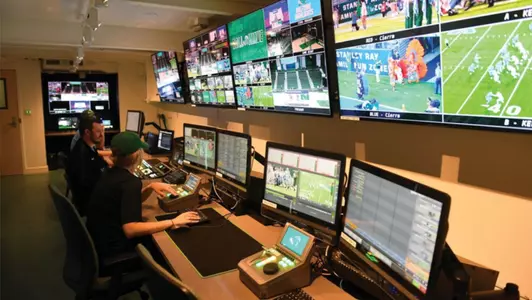
Home games for all three teams are broadcast from these venues, which also welcome tens of thousands of fans for the games each year. Around the time when The American signed a new 12-year, $1 billion new deal with ESPN, the Tulane University Athletic Department began considering upgrades that would raise the production value for live broadcasts and the in-venue fan experience. This required a near complete reimagination of their AV and broadcast infrastructure that included a new centralized control center to manage productions.
Of course being based in a busy urban area, along with the usual challenges of finding green space on a university campus, left Tulane University with limited options for the new facility.
"Tulane University is located in uptown New Orleans, and we operate in a landlocked region," said Andrew Alvarez, Director of Video and Broadcasting, Tulane University. "Space is always a premium on campus here. As we worked to identify the right location, we realized that refurbishing an existing space was our only viable option."
Alvarez and his colleagues envisioned a 1200-to-1500 square-foot space that could accommodate overlapping productions. Following a period of evaluation, they set their sights on an area inside Fogelman in Devlin that would provide substantially more room for technology and production personnel – certainly more than the existing control room, which Alvarez calls "a 6 by 10 closet."
Finding a much larger space also meant that it was time for significant technology upgrades to improve in-venue and outbound production value. In addition to enhancing control room technology and certain venue systems, it also meant establishing a completely new fiber and IP infrastructure between the control room and three venues.
While Alvarez would lead the charge from the inside, it was clear that a job of this scope required outside assistance.
"We needed a systems integration company, and in hiring one we really had to look at the integrator's past work," said Jana Woodson, Deputy Athletic Director for External Operations, Tulane University. "That included taking a close look at the systems they have set up on higher education campuses, especially when it came to sports production."
The decision was easy in the end given Woodson's previous experience with Technical Services Group (TSG), a Baton Rouge-based company, while in a similar role at Rice University. The TSG team handled the systems design and integration services for a central control room project at Rice, and both Woodson and Alvarez felt that previous experience made TSG the ideal fit.
The fact that TSG has near equal experience with broadcast and AV integration projects, and has experience with ESPN+ streaming systems – a key component of Tulane University's broadcast services – solidified their decision.
The Devlin's in the Details
The "Fogelman in Devlin" reference was added to the official Avron B. Fogelman Arena in Devlin Fieldhouse venue name in 2012, in honor of two long-time donors. The building itself, however, was constructed in 1933. The space identified for the new control room showed clear signs of age when the TSG team first walked through the doors. Lachin Architects was brought in to help TSG reimagine the space.
"We had to find a way to work within the existing framework," said AV Engineer Jason Martin, the lead TSG systems architect for the project. "Many steel beams and bulkheads added decades ago were in the way and simply immovable. As we planned a design around these obstacles, the Tulane Athletics Department brought in a general contractor and electrician to gut and rebuild the space. They completely redid all of the finishes, and installed a new electrical infrastructure and transformer."
The new electrical infrastructure provided TSG with a dedicated feed for the control room, as well as a smaller adjacent studio space that they had envisioned for press conferences and similar needs. "The dedicated feed is important to the integrity of the signals and production," said Martin. "Without that, the custom production team is sharing their electrical with the rest of the building. That can create havoc on the technology, such as interference from stadium lighting."
With outside electrical interferences gone, TSG and in-house technicians considered the interconnects to and from the three venues. They also worked closely with the campus IT department to establish a new fiber run.
"We had existing paths to each building and that made the project somewhat easier, but we still had to lay an entire new infrastructure," said Alvarez. "That included working with our cross-campus partners as we ran new conduit, and then ran cable for at least a half-mile. Our IT department was a huge help. We communicated where we wanted the demarcation points for each building, and how many strands were needed."
More than 100 strands of fiber were run between all locations, some being "dark fiber" that can immediately light up if other strands fail. Individual fiber strands are used for each camera feed, as opposed to muxing camera signals.
"Camera signal muxing is increasingly common, and that brings many different camera feeds onto a single fiber or sometimes a pair of fibers," said Martin. "All it takes is somebody tripping over the wrong cable to bring the entire show to a screeching halt. It costs a few more dollars to use individual strands for each camera, but it provides that extra layer of security for staying on the air if any fibers are damaged during the production. The production continues to maintain as many cameras as possible.
TSG opted for single-mode fiber to optimize video signal distance, and added CAT6a network cable and connectors to interconnects between all locations. TSG custom-built patchbays for use with the single-mode fiber at the venues, and added Attero Tech Dante I/O boxes to bring audio in and out for the patchbays. TSG also installed patchbays for SMPTE camera cables with both LEMO and Neutrik opticalCON DRAGONFLY connectors (a special technology explained later in the story), both of which are positioned around the venues for live video acquisition.
All of the networking components, according to Martin, are rated for 10Gb/s transfer.
"We futureproofed this facility as much as possible," said Martin. "The system can handle traffic for any device now, and anything that comes down the pipe over the next ten years."
That includes an IP network backbone between the switches. "We are using Extreme Networks' new 5520 switches," said Martin. "These are data center-grade switches used for communication between the venues. We have a 10Gig fiber path for Dante audio between the control room and Yulman and Turchin stadiums, and we use that same pipe to move control data between the venues and master control."
Video moves over a serparate fiber path, with Evertz 3405 fiber-optic SFP BNC frames powering transport. These are high-capacity bulk optical conversion platforms that can accommodate 16 Evertz 3405 Series SFPs, and up to 32 optical-to-electrical (or vice versa) conversions.
Evertz is one of the most strongly represented suppliers in the overall system. According to Martin, this is one of the earliest facilities to use Evertz's Scorpion MIO Dante modules for 64-channel Dante-to-TDM conversion.
Martin adds that most systems like this would utilize a third-party bridge to move between MADI audio and Dante. "MADI has traditionally been used for broadcast applications, and Dante for AV," he said. "The way we have configured this system just creates this huge universe of end points that the customer can leverage. That is very unique and we will see a lot more of this in the future."
Watching the Signals Flow
The Evertz gear, which also provides the routing and control solutions, are mostly centralized in master control. The facility's central EQX10 3G-SDI routing platform incorporates a wide variety of Evertz EQX modules to manage video processing, synchronization, and audio embedding and de-embedding and channel shuffling. The solution also integrates redundant Evertz MAGNUM servers, bringing everything inside the router under a single point of control. That includes control of Dante audio within the router, which Martin expresses as particularly on cutting-edge.
"Many venues still just use Dante on the edge devices, but this system utilizes Dante as the true audio backbone," said Martin. "We are routing Dante natively within MAGNUM control software, and this is also very new and unique."
MAGNUM is marketed as a unified control system that bridges all IP and SDI components in the workflow. TSG also added MAGNUM control software control keys for Evertz VIP7800 multiviewer layouts, audio processing and tally services. The latter pairs specifically with Evertz 7800 tally router, which supports networked and physical GPI and GPO.
Evertz VUE-Touch rackmountable control panels add further value inside the control room; the touchscreen panels are tailored with VUE widgets that interface with the router, multiviewer and Ross Video infrastructure gear.
The Ross Video gear plays an enormous role in the production workflow, with a Carbonite Black Plus production switcher, an Xpression real-time motion graphics platform, and Tria Express Duet servers all playing important roles. TSG designed two production workflows out of the Ross infrastructure, TD1 and TD2, that can be used separately or unified into "one giant workflow," according to Martin.
"We installed a single Carbonite Black Plus frame, and that is a 3 M/E switcher for two different productions," he said. "Rather than getting a 2 M/E control panel and 1 M/E, which is the traditional way, we decided to try a different approach. We procured two, 2 M/E panels, and everything comes out of the EQX router. We then mapped one of the mini M/Es inside the Carbonite platform to the second M/E on the TD2 panel.
"Since everything lands on the router and can recalled through the controller, we can make the TD2 side utilize two full M/Es," continues Martin as he demonstrates its flexibility. "We can move things around as much as we want with this configuration. We can do a linear and a board show, two linear shows or two board shows, and the technicians can move the stations around as they please."
Shift Those Gears
The Ross gear plays an important role in the fan experience, both in broadcast and inside the venues. The control room features three instant replay operator stations, with 12 inputs and six outputs shared amongst the three. A collection of freelance operators use Evertz Dreamcatcher instant replay servers, which are also used at the nearby Superdome and Smoothie King Arena.
"We wanted to use the same systems that the local replay talent pool are used to," said Martin. "It was a tough choice between the Ross Abekas Mira and Dreamcatcher, as we love both systems. Given the extensive local use of Dreamcatcher, it was the obvious choice for this project."
TSG went with the "married system" approach for replay to avoid what he calls "push-pull" between the different users. All replay content exists in a single database, and is available to all three operators in real-time. This architecture also allows operators to add markers on the same footage in real-time.
The replay content plays out on existing Daktonics video boards in each the venues, which the Tulane Athletics Department opted to keep both to save on costs and because they continue to perform very well. The Dreamcatcher and Daktronics combination play a very important role inside the venue.
"This new system tremendously improves our fan experience on campus," said Woodson. "A big part of that is because our staff and crew has modern equipment that better streamlines the workflow. Our fans can enjoy more amenities through in-venue elements that include videoboard capabilities, but also new fan interaction content capabilities that come with the new studio."
Any Color You Like
The small studio that Woodson references is the one that TSG carved out next to the control room. In addition to the press conferences mentioned earlier, the studio often hosts video shoots for athletes that are then shared with the replay operators. The studio includes a Dracast DRK1000 B3K lighting kit and a blue screen that production staff can use to create varied, colorful backgrounds. TSG also added audio jacks for wired and wireless microphones, SMPTE camera connections, and two permanently mounted Panasonic AW-UE70 PTZ cameras.
Audio capture and networking was the biggest investment inside the venue, along with patching systems to move audio and handheld camera signals – TSG supplied a Panasonic AJ-PX800 used between venues - back to the studio. That includes the aforementioned Attero Tech Dante I/O boxes that feed the patchbays and some equipment directly.
"We built XLR inputs and outputs on the patchbay systems that tie to the Attero Tech units," said Martin. "They can patch to any of our field plates, and provide input and output points in the technology core that serve any of the three venues. All of that audio is transported from those venues back to master control over the Dante network."
Shure VP89L (long condenser) and VP89M (medium condenser) shotgun microphones are used along with a Jony Shot parabolic microphone reflector inside the venue to capture crowd noise. These can be carried between venues and temporarily mounted. In addition, Shure MX183, MX185 wired lavalier microphones, and MX391 boundary microphones with inline preamps are used most often for basketball games.
"These are mainly used in the arena to pick up the sound from the court itself, whether along the boundary to pick up the rumble of the feet, on the backboards to catch the bounce of the ball, or near the rim to pick up the swoosh of the net," said Martin. "Neutrik opticalCON DRAGONFLY I/O boxes are used at both baskets to make the patching and unpatching as seamless as possible."
Martin adds that Tulane University is the first to add DRAGONFLY boxes to athletic venues in America, adding that Neutrik's expanded beam technology is what makes the product so special. This is especially important on the video side for camera content acquisition in the venues.
"There is a mating connector that focuses the camera signal back down into a fine fiber strand," he said. "In a traditional fiber system a small speck of dust can prevent the camera from operating. With these Neutrik connectors, the user can literally just exhale a little air from his or her mouth or from a can of compressed air. From there, the user can simply plug in and go. There is no more need to drag fiber cleaners along with the camera, or cross your fingers and hope that the optical strength is there in both directions upon plugging in the camera. It is a very special innovation in in both the AV and broadcast world."
Innovations like these are what are setting Tulane University Athletics apart as their new AV and broadcast systems come to life. All systems are ESPN and ESPN+ compliant for both broadcast and streaming productions. Woodson is especially proud knowing how it further electrifies the Athletics Departments brand.
"I oversee all athletic department areas that are externally facing, including broadcasting, marketing, sponsorship and creative services," said Woodson, who is also the sport supervisor for Green Wave beach volleyball, bowling, men's tennis and women's tennis.
"Our overall goal is always to build and proliferate the brand of Tulane Athletics. TSG and our entire video, broadcasting, facilities and operations staff worked tirelessly to make this project, systems and studio a reality. They all deserve credit for keeping this going amongst the pandemic, a Category 4 Hurricane and multiple scheduling changes."



Tulane Football Media Availability: RB Jaylin Lucas - 11/24/26
Tuesday, November 24
Tulane Football Media Availability: LB Makai Williams - 11/24/26
Tuesday, November 24
Tulane Football Media Availability: HC Will Hall - 11/24/26
Tuesday, November 24
Players Only Podcast - Jayda Brown & Ryan Blount
Monday, November 23