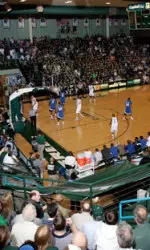
Fogelman Arena
Jan 13, 2011 | Women's Basketball
Located in the center of the Tulane campus, Avron B. Fogelman Arena is the home of the Green Wave men's and women's basketball and volleyball teams. Fogelman Arena provides Tulane teams and fans with a true home-court advantage with its size and unique design, which has translated into the many wins by all three programs.
In the summer of 2002, Fogelman underwent a facelift as the entire arena received a new coat of paint, the floor was redesigned, and, for the first time, air conditioning was installed in the arena.
In 2006, the original floor of Fogelman Arena was replaced with a state-of-the-art spring-mounted flooring, further enhancing the playing experience for Tulane student-athletes.
Now, the Tulane volleyball and men's and women's basketball teams practice and play in air-conditioned comfort while Tulane fans enjoy the best in Conference USA competition. One of the most difficult arenas for opposing teams to play in due to the Green Wave fans' close proximity to the playing surface, Fogelman Arena served as the host site of the 1999 and 2009 Conference USA Women's Basketball Championship and, for the first time in school history, hosted the C-USA Volleyball Tournament in 2003.
Fogelman Arena, one of the most historic facilities in college athletics, celebrates its 75th year as the home of the Green Wave in 2010-11, including the 35th year as the home court of the Tulane women's basketball team.
Construction for the original facility was funded by the Green Wave football team's appearance in the 1932 Rose Bowl. Some $80,000 was earmarked toward the building of a gymnasium. In fact, the facility was unofficially referred to as "Rose Bowl Gym" back in its early days.
Less than two years later, on Oct. 27, 1933, Tulane Gymnasium was dedicated as part of Homecoming festivities on campus, and play began in the facility for the 1933-34 season. Tulane defeated Southwestern Louisiana, 38-34, in the facility's first game on Dec. 15, 1933.
Tulane Gym was one of the largest in college athletics when it opened nearly 70 years ago, even though there were no court level seats at first. Tulane played host to the 1942 NCAA East Regional (basketball) in the facility. Floor-level seats were added in 1948.
The Green Wave basketball team played all of its home games in the facility until the mid-1970s, when a select number of games were moved to the Louisiana Superdome. The Wave moved all of its home games back on campus again in 1981-82 after another re-modeling job.
In 1982, the arena was the site of the National Association of Basketball Coaches All-Star Game in conjunction with Tulane's hosting of the Final Four. Tulane hosted the event again in 1993, along with the three-point and slam dunk competitions.
The arena is named for Memphis, Tenn., businessman and Tulane alumnus Avron B. Fogelman, who was one of the key figures in giving the Green Wave a new-look home back in the late 1980s.
While Fogelman Arena stands in the same frame and has much the same outside appearance as old Tulane Arena, that's where the similarities end. The inside of the arena underwent a major facelift, from all-new seating to a reconditioned playing floor and improved locker rooms to a new scoreboard.
The improved seating arrangement includes 850 chairback seats. Previously, all seats had been wooden bleachers. Other improvements included a new lobby and entrance area, concession and novelty stands throughout the arena, and media seating at courtside.
Some of college basketball's greats have played or coached on the corner of Freret and McAlister. Players such as Dan Issel, Dave Cowens and Pete Maravich graced Tulane fans with their talents, while the list of coaches to sit on the visitors' bench includes Adolph Rupp, Phog Allen, Everett Case and Dean Smith.