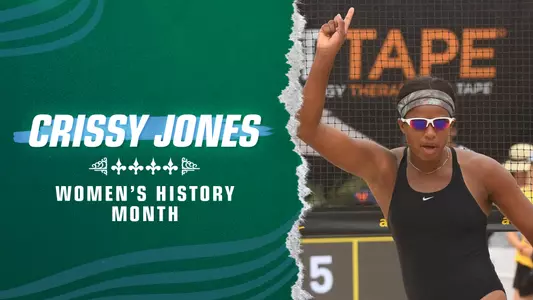
Tulane Beach Volleyball's Conversation with Crissy Jones
Mar 29, 2022 | Women's Beach Volleyball
NEW ORLEANS - Members of the Tulane beach volleyball team talked with Crissy Jones Schoonderwoerd about her experience as a black woman in professional beach volleyball in honor of both Black History Month and Women's History Month.
Freshman Ainsley Patrick wrote about their conversation below.
My teammates Maddie Speicher, Kara Griffin-Ruwin and myself were fortunate to talk with Crissy Jones Schoonderwoerd about her experience as a black woman in professional beach volleyball. We wanted to talk about representation in beach volleyball as well as look at the situation of diversity in the sport during Black History Month and Women's History Month.
One thing Crissy highlighted was the lack of representation she found in beach volleyball growing up. There were notably more indoor players that were women of color than players on the beach. Crissy had originally planned on playing indoor volleyball, attributing it partially to a greater amount of representation in indoor volleyball versus beach volleyball. She stated not having beach volleyball players to relate to in terms of "hey, I look like that person, or I can be this person."
We asked about those she looked up to before playing professionally herself.
"Growing up, I remember Misty and Kerri of course being kind of the two big dogs on the women's side for beach volleyball, reasonably so, they were incredible," Schoonderwoerd said. "But when I think about black women I think of Annett Davis, Jenny Johnson Jordan, and that's kind of it for that list, and that's tough."
Annett Davis and Jenny Johnson Jordan were notable women of color in the sport, winning a silver medal in the 1999 world championships and representing the U.S. in the 2000 Olympics placing fifth. These two were trailblazers in the world of beach volleyball and although representation in the sport has grown a large majority of the players are still white. Crissy talked about how she notices there are times when she is the only black woman playing in a tournament, although it's something she's gotten used to, she still finds it difficult at times because of the specific look beach volleyball players are expected to have. Reforming this idea of the typical beach volleyball player look is important to open up the sport to all younger players.
Something that helps this reform by growing the sport is the addition of beach volleyball in the NCAA. Because of the instatement of beach volleyball, tournaments for junior players have grown as well. More girls are signing up to play as juniors and can recognize role models in professional and college players that they can see themselves being. When she first got to the tour, Crissy noticed how her skin color made her stand out, as she and only a few other women were women of color around her. She stated that the success in her career gives her confidence, and she's been able to overcome the challenge of looking different than most players on tour through her successes and embracing who she is.
One thing that is very important to Crissy is knowing that she can provide the representation that was mostly absent when she was younger.
"I can be a role model for a girl who looks like me who says, 'hey mom, I want to play beach volleyball and I get to watch Crissy. . . and she looks like me," Schoonderwoerd said. "Getting to inspire younger players who look like me has been something that definitely fulfills me."
The sport is growing and the direction that Crissy and other players of color are taking it can make a big difference in the representation that younger players see and can aspire to be. We are very thankful to Crissy for taking the time to talk with us as well as for the representation she and other professional players provide for the next generation.
Freshman Ainsley Patrick wrote about their conversation below.
My teammates Maddie Speicher, Kara Griffin-Ruwin and myself were fortunate to talk with Crissy Jones Schoonderwoerd about her experience as a black woman in professional beach volleyball. We wanted to talk about representation in beach volleyball as well as look at the situation of diversity in the sport during Black History Month and Women's History Month.
One thing Crissy highlighted was the lack of representation she found in beach volleyball growing up. There were notably more indoor players that were women of color than players on the beach. Crissy had originally planned on playing indoor volleyball, attributing it partially to a greater amount of representation in indoor volleyball versus beach volleyball. She stated not having beach volleyball players to relate to in terms of "hey, I look like that person, or I can be this person."
We asked about those she looked up to before playing professionally herself.
"Growing up, I remember Misty and Kerri of course being kind of the two big dogs on the women's side for beach volleyball, reasonably so, they were incredible," Schoonderwoerd said. "But when I think about black women I think of Annett Davis, Jenny Johnson Jordan, and that's kind of it for that list, and that's tough."
Annett Davis and Jenny Johnson Jordan were notable women of color in the sport, winning a silver medal in the 1999 world championships and representing the U.S. in the 2000 Olympics placing fifth. These two were trailblazers in the world of beach volleyball and although representation in the sport has grown a large majority of the players are still white. Crissy talked about how she notices there are times when she is the only black woman playing in a tournament, although it's something she's gotten used to, she still finds it difficult at times because of the specific look beach volleyball players are expected to have. Reforming this idea of the typical beach volleyball player look is important to open up the sport to all younger players.
Something that helps this reform by growing the sport is the addition of beach volleyball in the NCAA. Because of the instatement of beach volleyball, tournaments for junior players have grown as well. More girls are signing up to play as juniors and can recognize role models in professional and college players that they can see themselves being. When she first got to the tour, Crissy noticed how her skin color made her stand out, as she and only a few other women were women of color around her. She stated that the success in her career gives her confidence, and she's been able to overcome the challenge of looking different than most players on tour through her successes and embracing who she is.
One thing that is very important to Crissy is knowing that she can provide the representation that was mostly absent when she was younger.
"I can be a role model for a girl who looks like me who says, 'hey mom, I want to play beach volleyball and I get to watch Crissy. . . and she looks like me," Schoonderwoerd said. "Getting to inspire younger players who look like me has been something that definitely fulfills me."
The sport is growing and the direction that Crissy and other players of color are taking it can make a big difference in the representation that younger players see and can aspire to be. We are very thankful to Crissy for taking the time to talk with us as well as for the representation she and other professional players provide for the next generation.
Players Mentioned

/ Women's Beach Volleyball

/ Women's Beach Volleyball

/ Women's Beach Volleyball
Tuesday, January 30
Wednesday, May 27
Sunday, November 10
Wednesday, October 23