Tulane's Past and Present Meet for Memorable 1979 Team Reunion
Apr 18, 2019 | Baseball
By Clyde Verdin
TulaneGreenWave.com
Standing in the dugout amid a throng of players, Joe Brockhoff has a smile from ear to ear.
The longtime former Tulane coach had just watched the Tulane Green Wave baseball team, his former team, score 20 runs in a win over the USF Bulls to claim the series on a sun-splashed day at Greer Field at Turchin Stadium.
With the entire team having his undivided attention, his message to the group was pretty simple and got to the point pretty quickly.
"I'm an old hitting coach, and I love watching you guys hit the ball," Brockhoff said with a laugh.
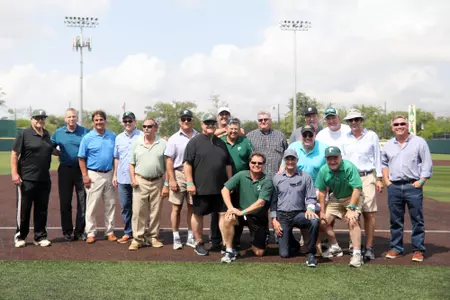
On a day that began under a tent reminiscing on past glory, more than a dozen members of the 1979 Tulane baseball team that won the Metro Conference Tournament and went to an NCAA regional for the first time saw the 2019 take a few more steps towards meeting that same goal.
It's a goal that's become all too commonplace in Tulane history, qualifying for the postseason and trying to make a run to the Holy Grail of college baseball in Omaha, Nebraska in June. But there's always a first, and that first took 73 years to reach and a team of 28 players that seemed ready to strike while the iron was hot.
"The '79 team was special because we had a lot of leadership, a lot of juniors and seniors, with a lot of it attributable to coach Brockhoff and what he did," infielder and team captain David Stokes said.
After eight years under Milt Retif, Brockhoff took the reigns for the 1975 season and had a pair of 24-win seasons, before a breakout season of 32 in 1977. In 1978, the Metro Conference began and Tulane one nine of their 25 games in that new league to finish second.
From the start of the 1979 season, an unstoppable force emerged Uptown that saw this team never lose more than two games consecutively at any point throughout the course of the season. 1979 saw a pair of wins over LSU and four wins in five games against Wisconsin and regional rivals ULM, among others.
"Everything just came together for us year," Brockhoff said. "We had good pitching, good defense, and good hitting, something that was not easy for us to put together here prior to that time."
Brockhoff credits Retif for not only being able to keep local talent within the state's borders, but also helping get the New Orleans and surrounding communities involved in the program to help it grow from what it was before Retif took over in 1967 to what it eventually became under Brockhoff.
"When I came in, the seeds were already planted, so I looked at it like a relay team where I just took the baton and tried to take it to the next level," he said.
Tulane took a liking to the Metro when the league started in 1978, as the Green Wave went 9-2 in the conference to build some momentum. However, when the conference tournament rolled around the team suffered a 17-12 loss to Cincinnati and 3-2 loss to Florida State in its home park to end the season.
The next year, the team only played four games in the league and dropped all of them to both the Seminoles and Memphis to go from finishing second the previous year, to seventh. In the run up to that year's Metro tournament back in Tallahassee, Tulane was 4-3 over its final seven games with a win over New Orleans to end the year on a high note.
But according to Stokes, the confidence of that year's team couldn't be underestimated.
"We were confident," he said. "We went into that tournament at Florida State knowing that we were going to win."
Over the course of three days in Florida's capital, the Green Wave outscored their opponents 30-14 and defeated the host-Seminoles over the course of the final two days to claim the tournament championship for the first time earning an NCAA berth.
"It was just a wonderful experience going into any game that we possibly went into and never felt like an underdog," Stokes said. "We were the team to beat."
At the NCAA South Regional in Starkville, Tulane fell in a close game to Murray State 5-3, before ending the year with a 12-4 loss to Mississippi State the next day.
From that point, Tulane qualified for an NCAA regional six more times before he eventually passed the baton to Rick Jones in 1994. The foundation set, Tulane ascended into the national discussion as one of the teams of the 90's and 00's with College World Series appearances and conference championships.
"What coach Brockhoff did all the way from that point until the early 90's when coach Jones took over, he just took this program to the absolute next level." Stokes said. "But it was all built upon what transpired in the late 70's and throughout the decade of the 80's, and the '79 team was the start of that."
For Brockhoff, leading that Tulane team to success was about more than the success on the field and championships won. For him, it was the culmination of a lifelong love affair with Tulane that led to him being a part of one of the historic days in Green Wave history.
"Tulane for me began in 1949. I was a Boy Scout and attended football games here. I saw Tulane win the SEC and from there it was in my blood," he said. "To be able to come in after coach Retif and build the program was a great dream that came through. I was very fortunate that we had players take the long bus rides and do all the things that you have to do to be successful. And they did."
Huddled up outside of the tent that provided more shade than anything else, the group got their marching orders and began to make their way to the door that leads to the home dugout down the third base line. Waiting for them were the 18-21-year-olds that were just as anxious to meet them and hear their stories of seasons gone by.
Greer Field at Turchin Stadium is a very different site than the field the 1979 team played on, but those memories that flood back are all still the same.
"When I first came here, our press box looked like a duck blind, and that's what most people called it," Brockhoff said. "But each year things got better, and you look at this place now and you're just happy that you were a part of this in some way."
With about 20 minutes to first pitch, one-by-one the members of that 1979 team run out to their former places on the diamond 40 years into the future. As the videoboard flashes pictures and some video of that team Brockhoff begins his stride to the mound for the day's ceremonial first pitch.
Awaiting that pitch is current Tulane head coach Travis Jewett, arm extended and glove open and ready for the catch.
Straight and true, the ball hits the mitt and Jewett gives the call sign for the strike.
Just like old times.
Tulane went on to win the game, much to the delight of everyone in the crowd and a group of players and coach who all too intimately know the grind of a long baseball season. And for Jewett, having that piece of Tulane history in the park that day was a huge boon for himself and the team.
"It's an honor to be a part of that lineage, and to see the smiles on their faces was amazing for all of us," Jewett said. "To have our kids engaged was so cool, and it just goes back to the honor and respect you have for the game and the players who have come before them."
The remnants of a great day are still there to be found well after the game is over, as good friends have long said their goodbyes to each other. There is still one baseball game left to play that weekend, but on this Saturday the past and present came together in a way that makes the game of baseball special and links generations together.
"When you think of how long 40 years is, you realize that not everybody looks the same, but the feelings and emotions you feel are still strong," Stokes said. "I'm proud to represent Tulane and to be a part of this great university, and days like today make me so thankful that I was able to be a part of it."
TulaneGreenWave.com
Standing in the dugout amid a throng of players, Joe Brockhoff has a smile from ear to ear.
The longtime former Tulane coach had just watched the Tulane Green Wave baseball team, his former team, score 20 runs in a win over the USF Bulls to claim the series on a sun-splashed day at Greer Field at Turchin Stadium.
With the entire team having his undivided attention, his message to the group was pretty simple and got to the point pretty quickly.
"I'm an old hitting coach, and I love watching you guys hit the ball," Brockhoff said with a laugh.
On a day that began under a tent reminiscing on past glory, more than a dozen members of the 1979 Tulane baseball team that won the Metro Conference Tournament and went to an NCAA regional for the first time saw the 2019 take a few more steps towards meeting that same goal.
It's a goal that's become all too commonplace in Tulane history, qualifying for the postseason and trying to make a run to the Holy Grail of college baseball in Omaha, Nebraska in June. But there's always a first, and that first took 73 years to reach and a team of 28 players that seemed ready to strike while the iron was hot.
"The '79 team was special because we had a lot of leadership, a lot of juniors and seniors, with a lot of it attributable to coach Brockhoff and what he did," infielder and team captain David Stokes said.
After eight years under Milt Retif, Brockhoff took the reigns for the 1975 season and had a pair of 24-win seasons, before a breakout season of 32 in 1977. In 1978, the Metro Conference began and Tulane one nine of their 25 games in that new league to finish second.
From the start of the 1979 season, an unstoppable force emerged Uptown that saw this team never lose more than two games consecutively at any point throughout the course of the season. 1979 saw a pair of wins over LSU and four wins in five games against Wisconsin and regional rivals ULM, among others.
"Everything just came together for us year," Brockhoff said. "We had good pitching, good defense, and good hitting, something that was not easy for us to put together here prior to that time."
Brockhoff credits Retif for not only being able to keep local talent within the state's borders, but also helping get the New Orleans and surrounding communities involved in the program to help it grow from what it was before Retif took over in 1967 to what it eventually became under Brockhoff.
"When I came in, the seeds were already planted, so I looked at it like a relay team where I just took the baton and tried to take it to the next level," he said.
Tulane took a liking to the Metro when the league started in 1978, as the Green Wave went 9-2 in the conference to build some momentum. However, when the conference tournament rolled around the team suffered a 17-12 loss to Cincinnati and 3-2 loss to Florida State in its home park to end the season.
The next year, the team only played four games in the league and dropped all of them to both the Seminoles and Memphis to go from finishing second the previous year, to seventh. In the run up to that year's Metro tournament back in Tallahassee, Tulane was 4-3 over its final seven games with a win over New Orleans to end the year on a high note.
But according to Stokes, the confidence of that year's team couldn't be underestimated.
"We were confident," he said. "We went into that tournament at Florida State knowing that we were going to win."
Over the course of three days in Florida's capital, the Green Wave outscored their opponents 30-14 and defeated the host-Seminoles over the course of the final two days to claim the tournament championship for the first time earning an NCAA berth.
"It was just a wonderful experience going into any game that we possibly went into and never felt like an underdog," Stokes said. "We were the team to beat."
At the NCAA South Regional in Starkville, Tulane fell in a close game to Murray State 5-3, before ending the year with a 12-4 loss to Mississippi State the next day.
From that point, Tulane qualified for an NCAA regional six more times before he eventually passed the baton to Rick Jones in 1994. The foundation set, Tulane ascended into the national discussion as one of the teams of the 90's and 00's with College World Series appearances and conference championships.
"What coach Brockhoff did all the way from that point until the early 90's when coach Jones took over, he just took this program to the absolute next level." Stokes said. "But it was all built upon what transpired in the late 70's and throughout the decade of the 80's, and the '79 team was the start of that."
For Brockhoff, leading that Tulane team to success was about more than the success on the field and championships won. For him, it was the culmination of a lifelong love affair with Tulane that led to him being a part of one of the historic days in Green Wave history.
"Tulane for me began in 1949. I was a Boy Scout and attended football games here. I saw Tulane win the SEC and from there it was in my blood," he said. "To be able to come in after coach Retif and build the program was a great dream that came through. I was very fortunate that we had players take the long bus rides and do all the things that you have to do to be successful. And they did."
Huddled up outside of the tent that provided more shade than anything else, the group got their marching orders and began to make their way to the door that leads to the home dugout down the third base line. Waiting for them were the 18-21-year-olds that were just as anxious to meet them and hear their stories of seasons gone by.
Greer Field at Turchin Stadium is a very different site than the field the 1979 team played on, but those memories that flood back are all still the same.
"When I first came here, our press box looked like a duck blind, and that's what most people called it," Brockhoff said. "But each year things got better, and you look at this place now and you're just happy that you were a part of this in some way."
With about 20 minutes to first pitch, one-by-one the members of that 1979 team run out to their former places on the diamond 40 years into the future. As the videoboard flashes pictures and some video of that team Brockhoff begins his stride to the mound for the day's ceremonial first pitch.
Awaiting that pitch is current Tulane head coach Travis Jewett, arm extended and glove open and ready for the catch.
Straight and true, the ball hits the mitt and Jewett gives the call sign for the strike.
Just like old times.
Tulane went on to win the game, much to the delight of everyone in the crowd and a group of players and coach who all too intimately know the grind of a long baseball season. And for Jewett, having that piece of Tulane history in the park that day was a huge boon for himself and the team.
"It's an honor to be a part of that lineage, and to see the smiles on their faces was amazing for all of us," Jewett said. "To have our kids engaged was so cool, and it just goes back to the honor and respect you have for the game and the players who have come before them."
The remnants of a great day are still there to be found well after the game is over, as good friends have long said their goodbyes to each other. There is still one baseball game left to play that weekend, but on this Saturday the past and present came together in a way that makes the game of baseball special and links generations together.
"When you think of how long 40 years is, you realize that not everybody looks the same, but the feelings and emotions you feel are still strong," Stokes said. "I'm proud to represent Tulane and to be a part of this great university, and days like today make me so thankful that I was able to be a part of it."
Tuesday, November 04
Saturday, February 22
Friday, February 21
Tuesday, November 26