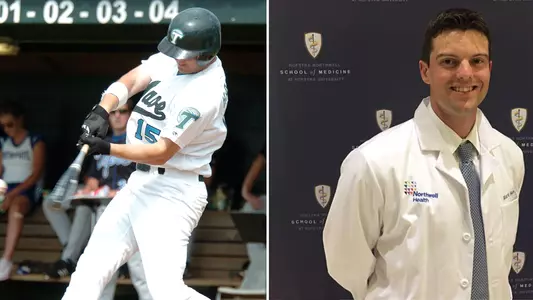
Mark Hamilton Taps Into Tulane Baseball Pedigree to Join Coronavirus Fight, Reach Heights of Lifelong Idol
Apr 17, 2020 | Baseball
By Adam Miller
Tulane University Athletics
Everyone calls him 'Hammy’ but now he’s ‘Dr. Hammy.' There are very few guys who have done the things he has in his life.-Longtime Tulane baseball head coach Rick Jones
Hard work gifts many people with opportunities to show what they are made of when they reach the pinnacle of their profession. That applies especially to athletes and doctors, and former Tulane University baseball standout Mark Hamilton is one in a small number of people in human history who is on the verge of saying he’s made a significant contribution at the highest level of both fields.
One of the best to ever do both in one lifetime has been an idol of Hamilton’s since he was a young boy. Nicknamed the “Golden Boy” during his time with the New York Yankees, Dr. Bobby Brown was assigned to Tulane Medical School as a midshipman and starred in his lone season with the baseball team in 1945.
He convinced the dean of the medical school that he could play and still complete his studies, before eventually signing a contract with the Yankees in early 1946. Brown was a key piece in helping the Yankees win four World Series titles, before enjoying a career as a cardiologist.
“That was my story that I held onto growing up,” Hamilton said. “My dad told me Dr. Brown’s story when I was very young – single digits easily – and I still remember it. He told me it can be done by the right person with the ability and the drive to be successful in these two fields. Dr. Brown has always been an inspiration.”
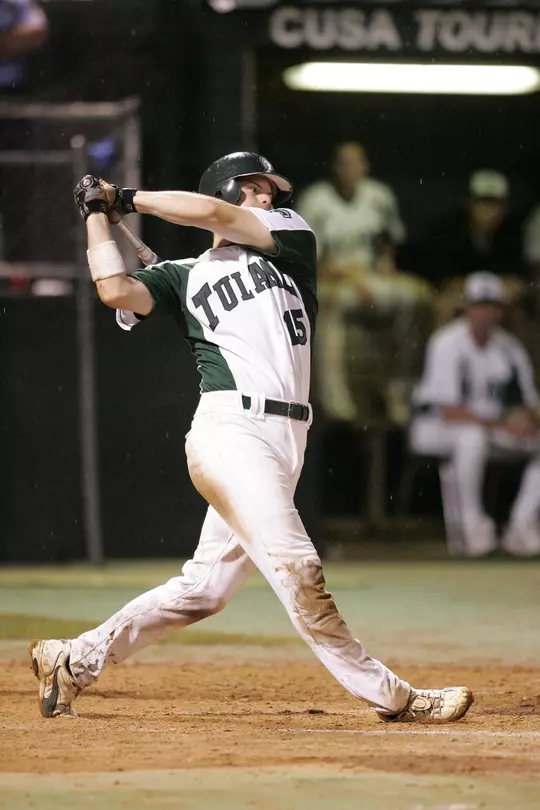
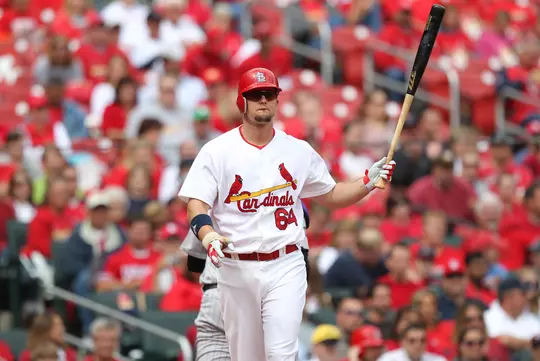
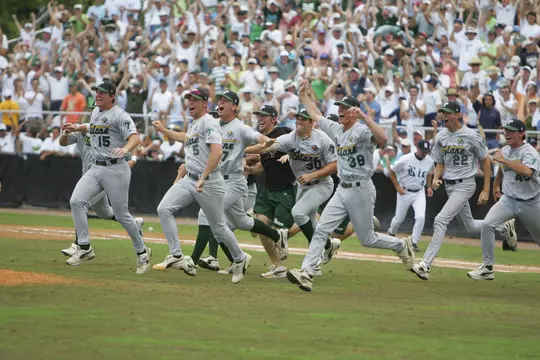
Hamilton donned Tulane’s “Slugger Bird” jersey during the baseball program’s journey to Omaha for the 2005 NCAA College World Series. A second-round selection in the 2006 Major League Baseball draft, when he reached the big leagues, he wore the signature “Birds on the Bat” threads for the St. Louis Cardinals in 2010 and 2011 on his way to earning a World Series ring.
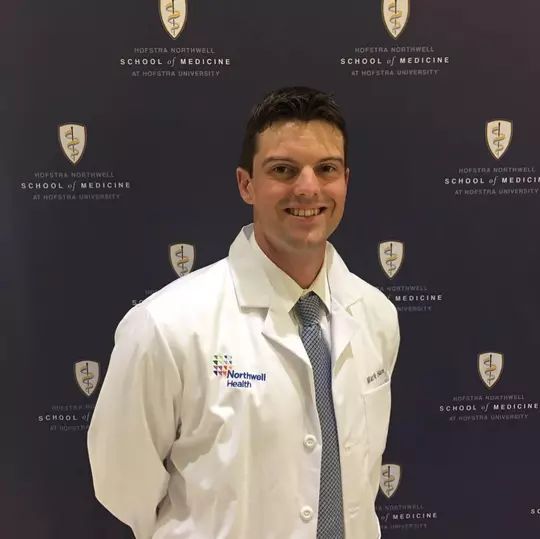
Fast forward nine years later, and Hamilton has been fast-tracked to complete his doctorate degree from the Zucker School of Medicine at Hofstra University and join the fight against the COVID-19 pandemic.
In June, Hamilton begins his first year as an internal medicine resident at Long Island Jewish Medical Center and North Shore University Hospital. Among his responsibilities, he will find himself on the front lines of the virus outbreak where his efforts will be concentrated on evaluating patients admitted to the facilities and determining a medical management plan for their ongoing problems. Subsequently, he will turn his focus to the field of interventional radiology.
Some might call that progress, but if they joined him on every other adventure he’s taken, they might correct you and say that’s just another example of what’s in his nature. His purpose. His DNA.
“I grew up around medicine, and this is something I’ve always wanted to do after my baseball career,” Hamilton said.
His father, Stanley, was the longtime head of pathology and laboratory medicine at MD Anderson Cancer Center in Houston. He currently holds the same position at the City of Hope Center in Southern California.
Transition has always been a common theme for Hamilton, and that started in the classroom as a freshman at Tulane in 2003. He studied molecular biology as an undergraduate, before embarking on his MLB career in 2006. After nine productive pro seasons that included 108 home runs in the minor leagues, Hamilton returned Uptown and earned his bachelor’s degree in neuroscience.
“That was always the goal,” Hamilton said. “I wanted to go to a place where, no matter what happened in my baseball career, I would come out the other side with the ability to go to medical school. I felt like Tulane offered that, and not everywhere else would.”
The same way his practices and studies have shifted in the field of medicine, Hamilton was asked to do the same during his time on the baseball diamond at Tulane. In 57 games played as a sophomore during the Green Wave’s run to Omaha, he saw playing time in left field, right field, at first base and designated hitter.
Tulane posted 56 wins that spring, and after Hurricane Katrina ravaged the city a few months later, the team relocated to Lubbock, Texas for the fall semester. The Green Wave returned to New Orleans the following spring, and Hamilton erupted for a remarkable season that garnered him Conference USA Player of the Year honors and the program a trip to a regional final.
I wanted to go to a place where, no matter what happened in my baseball career, I would come out the other side with the ability to go to medical school. I felt like Tulane offered that, and not everywhere else would.
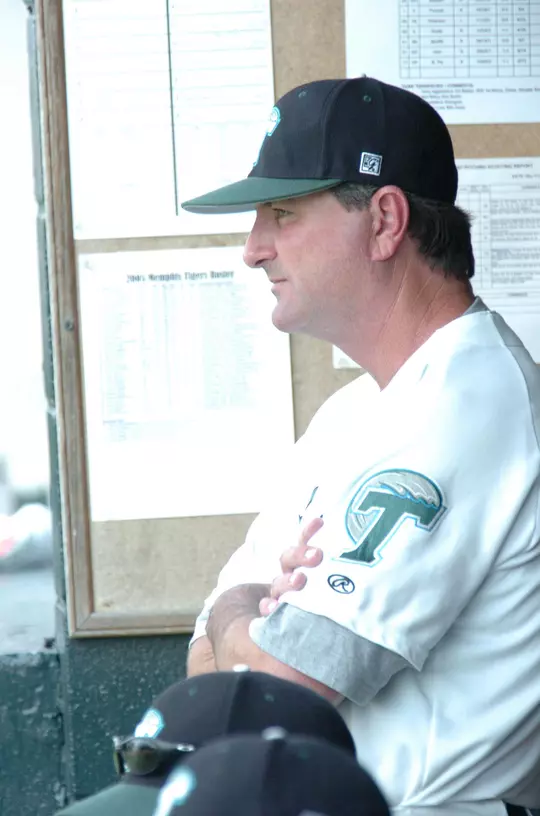
“He made himself into a really good outfielder because he started out as a first baseman for us,” said longtime Tulane head coach (1994-2014) Rick Jones. “We knew he was a very talented player when we recruited him, and we alternated him a bit when Micah (Owings) was pitching. He didn’t have a lot of experience moving around like that in high school.”
It’s easy for someone to say they put in the time and effort. Some even believe their hard work goes unnoticed and their morale drops. Hamilton’s efforts were so disciplined that he couldn’t be ignored because of the amount of time he put into his game and his studies. It was impossible for his college skipper not to notice he had something special on his team.
“His work ethic was outstanding,” Jones said. “He was always there early and stayed late. It carried over into the classroom. He wasn’t average or above average, but a tremendous student at the highest level.”
Currently the Green Wave’s pitching coach and a 2019 Tulane Athletics Hall of Fame Inductee, Daniel Latham was Hamilton’s teammate during each of his three seasons of college ball. Latham’s relationship with Hamilton extends beyond the diamond, as he was in Hamilton’s wedding party.
“We all knew he was really intelligent and driven,” Latham said. “He knew a lot about a lot of things. We would joke that he’s in the top one percent of the top one percent as a former Major League Baseball Player and a doctor. That’s a pretty rare combination.”
Latham hopes he’s able to bring a few more student-athletes with Hamilton’s athletic and academic work ethic on board during his tenure.
“We want kids at Tulane who desire both sides of it,” Latham said. “It’s a big selling point for us now, and it was a drawing point for me when I signed. We’d love to find more kids like that, but there aren’t many out there who can do both at a high level.”
The parallel of Hamilton’s proven flexibility and experience in multiple areas of both sports and medicine validates his candor.
“If you have the ability and curiosity to learn you can accomplish a lot,” Hamilton said. “What you can accomplish is through work ethic and being fully engaged. Baseball taught me to tailor my life to be successful in my goals, and I don’t think that really changes in medicine.”
Hamilton has teed up thousands of balls in the batting cage to put his best swings on pitches, studied opposing pitchers on film and done everything he could to prepare for his next at-bat. Every procedure and examination he performs on his patients is a constant effort to improve his skill as a physician.
The content may differ from how he practices or goes about learning to hit a curveball versus running medical instruments into human organs, but the objective to find a way to accomplish the task at hand remains constant.
“It’s all scouting,” Hamilton said. “Whenever you are prepared, you are going to be as successful as you can be. Whatever the task is, find a way to be prepared so that whatever occurs feels like something I’ve done before. That’s what medical training is. It’s seeing so many different scenarios, and it takes so many repetitions and practice in order to become an expert in these difficult fields. If you put the time in and have the focus and work ethic, you will find a way.”
Hamilton’s discipline and focus on being his best are not solely concentrated on incentives that only benefit his personal goals. He always has his unique experiences contributing to championship-caliber baseball clubs at the collegiate and professional levels in his arsenal, and thus, the understanding of the importance of teamwork.
“Successful teams are the ones where everyone has the same goal,” Hamilton said. “In medicine, there is really no difference, but the winning is different. Everyone is there to improve the patient and get them well.”
Teamwork extends beyond the ballparks, hospitals and classrooms. Now more than ever, the United States and hundreds of countries around the world are being asked to come together in a way they haven’t had to in the modern history of a world with expanded technology and a greater understanding of medicine due to a global pandemic.
The world is being asked to contribute together through aggressive physical and social distancing measures that have slowed economies to a crawl across the globe.
“When people face adversity there are two outcomes: they come together to find a way to beat it or they fall apart,” Hamilton said. “It’s the ones that find that unifying piece of the puzzle that are really successful. Right now, we’re sharing a lot of adversity across the world, but it’s really bringing us together to find a purpose and a way to pitch in and be successful.”
While the pandemic is spread out on a much larger scale than the natural disaster that was Hurricane Katrina, Hamilton was a witness to post-Katrina New Orleans and the efforts of the people that made the city stronger in the storm’s aftermath.
“A lot of it is solidarity,” Hamilton said. “There are a lot of parallels. The city bounced back so well because it was a very unifying experience for everyone that was there. With the virus crisis, I hope we come out with a lot more solidarity and respect for everyone’s well-being.”
When people face adversity there are two outcomes: they come together to find a way to beat it or they fall apart. It’s the ones that find that unifying piece of the puzzle that are really successful.-Mark Hamilton

While the world waits to return to normalcy, Hamilton is forcing his way into making that a reality for people. He’s set to join his new team on the front line in short order, but Coach Jones would like to see him on one more of his teams.
“Everyone calls him ‘Hammy’ but now he’s ‘Dr. Hammy,’” Jones said. “There are very few guys who have done the things he has in his life, and I’m really proud of him. There is no question in my mind that it won’t be long before Mark is inducted into Tulane’s Hall of Fame. He’ll be well-deserving.”
And while Hamilton readies for whatever is next along his journey as a practicing doctor in New York, maybe there’s a chance he’ll finally have that run-in with his lifelong idol, Dr. Brown. After all, so many others have done so in recent years.
But how special would it be for a man like Dr. Brown, who is currently 95 years old and has shaped the career path of another man who is almost exactly six decades younger, to meet Mark Hamilton?
“I’ve run into so many people who know him, but for whatever reason, we’ve never been able to cross paths,” Hamilton said. “I was supposed to meet him at Tulane at a luncheon, but I can’t remember if it was exams or something else that prevented me from being there. If I ever got the opportunity to meet him, I’d love to get to know him.”
Hamilton isn’t chasing his idol. He’s becoming him.
Fans can follow Tulane Athletics on Twitter, Facebook, Instagram.
WE ARE NOLA BUILT
Tulane University is located in the city of New Orleans. It is a city built on tradition and resiliency. The lessons Green Wave student-athletes have learned through their connection with this university and city have BUILT doctors, lawyers, business leaders, conference champions, all-conference players, all-Americans, professional athletes and NCAA tournament teams. The city of New Orleans has shaped us into who we are today. We are One City. We are Tulane. We are NOLA BUILT. Check out our story at NolaBuilt.com.